Are AI-generated Artworks in Copyright Infringement?
- thefelttipfaerie

- Nov 30, 2025
- 10 min read
Updated: Dec 5, 2025
The short answer is: probably. There is copyright infringement in AI-generated artwork and companies that train their AI are probably breaking copyright, but it’s not in the way that you might expect!
That’s because there are two ways that you can think about how AI-generated artwork could break copyright:
Training of the model
Creation of the images
What’s the problem with copyright infringement in AI-generated artworks?
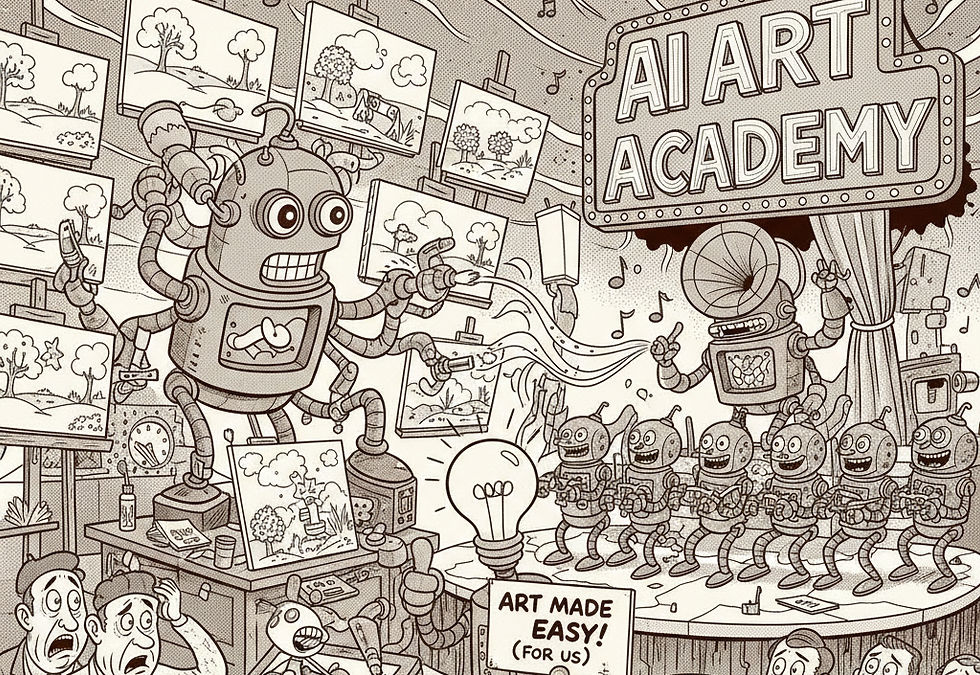
Artists, authors, musicians and creators are in outrage over copyright infringement in AI-generated artworks. ChatGPT, Gemini, Meta and other AI models are “stealing work” and “breaking copyright". But are they? On the other end of the spectrum, people are arguing that AI is part of their constitutional rights or are happy to share their work as part of the dataset.
There are a lot of things to unpack with this topic!
Is the new generation of AI models in breach of copyright? Does copyright still make sense in the world of AI? Is it all about the money? Does AI mean the end of creativity, or will it spark a new era? Maybe AI will eventually overthrow us and “kill all humans”? Is it something more nuanced entirely?
Let’s explore!
What is copyright?
Copyright varies wildly from country to country, with the USA having stricter standards, whilst China has infamously lax copyright protection.
One of the first recorded copyright cases (technically an unfair competition case) was in 1511: Albrecht Dürer vs. Marcantonio Raimondi. Raimondi copied Dürer’s engravings, even Dürer’s “logo”! So Dürer took Raimondi to court and had a (partial) victory.
Why does copyright exist?
Copyright is largely seen as a way of protecting creatives and the arts.
“If authors or performers are to continue their creative and artistic work, they have to receive an appropriate reward for the use of their work... Adequate legal protection of intellectual property rights is necessary in order to guarantee the availability of such a reward...” - European Union

What is a copyright infringement?
As copyright varies wildly from country to country, it’s hard to make a clear distinction. I live in Europe, and so will focus on EU legislation.
Copyright infringement in its simplest form:
If someone looks at/watches/hears a piece of artwork and says “hey, that’s exactly the same as this other thing” then it’s probably infringing copyright.
If you take a “substantial part” of the work, you’re breaking copyright, this includes a small, but distinctive part: e.g. the touching hands of God and Adam.
Modern and obvious copyright infringement cases include Andy Warhol’s work, Jeff Koons' String of Puppies (1988) and Shepard Fairey’s Obama “Hope” Poster (2008).
Are there exceptions to copyright law?
There are some exceptions when people can reproduce an image, song or other creative medium that wouldn’t count as a copyright infringement, including but not limited to:
Being “Generic”
If something is generic enough, copyright no longer stands. A famous example of something being recognisable, but also generic is Ed Sheeran’s 2023 copyright trial where Sheeran was able to prove that the chords he’d used in his song “Thinking Out Loud” were similar, not only to the 1973 classic Let's Get it On by Marvin Gaye, but to multiple songs before 1973.
Another example might be Instagram user nateinthewild. Whilst he is right, there are similarities between his image and the AI-generated artwork, there are lots of similarly generic images online, so it’s not clear if there is copyright infringement in the AI-generated artwork. Especially if we consider how the algorithm to generate AI art works.
Death
Copyright only applies for a given period of time. Namely the life of the artisan plus a number of years. So you can go ahead and reprint classic literature without fear of copyright infringement.

Parody / caricature
Parodies are allowed, but they must acknowledge the original, be noticeably different, and actually be funny, or at least attempt to be. Friday Night Live is famously good at this. Another great example is Banksy’s Dismaland.
As a reference/inspiration
You can be inspired by someone’s work and borrow ideas, then design your own scene with different characters, poses, lighting, etc, but this can be dangerous.
Reporting/News
For example, if the king commissions a new portrait, an image of the portrait can be included as part of the news article, but the image cannot be sold for profit, e.g. as a print.
Education
An art student can photocopy work or sketch from paintings as part of their studies, but cannot sell this work as their own.
Is there a copyright infringement when an AI generates artworks?
The short answer is no, but there are edge cases where there might be!
Examples of AI copyright infringement edge cases:
If an AI model closely reproduces a copyrighted character, logo, or composition e.g. Homer Simpson
If an AI model effectively recreates a training image (similar to the “substantial part” cited above).
AI models are “inspired” by the work that they “see”, and this is nothing new. People have always been inspired by others. From painters imitating Caravaggio’s use of lighting to the alleged cultural appropriation of Picasso in works such as Les Demoiselles d’Avignon.
An AI model creates statistically probable outcomes, based on random “seeds” (it’s just guessing what the next most likely pixel will be). The AI-generated artwork is not in itself infringing copyright.
How does an AI model learn?
An AI model is trained on a “data set”. This is a huge number of files: text, video, images, scans, DNA, etc. This data is collected and copied to a hard drive and “fed” to neural networks so they can learn a given skill e.g. what a cat looks like, how a pop song sounds or what breast cancer looks like.
This is where copyright comes into question: the fact that the data used to do this is copied and where this data is copied from!
Where does the data used to train AI come from?
Whilst a lot of AI models have been trained on open source data, many have not. It has been revealed that many of the leading AI companies, including Meta, OpenAI and others have used the now infamous Books3 database to train their AI models.
What the problem with the Books3 Database?
These books are torrented. While torrenting itself is not illegal, downloading or “copying” copyrighted material is. And this is where people claim the copyright infringement in AI-generated artworks is really happening!

It’s not just Copyright infringement, emotion is at play too!
But why are creators so upset about this? Almost everyone has screenshot a copyrighted image, watched an illegally uploaded music video on YouTube, looked up some illegally created sheet music or torrented a TV series they were unable to access in their home country. So why are artists so upset that OpenAI and Meta have done the same?
Because it just feels different when a large company profits from your work and a teenager screenshots it and uses it as their wallpaper!
This gif is an interesting and questionable copyright infringement!
Are we Scared? AKA Will AI "Destroy All Humans?”
Humans are often scared of intelligence, any very clever person will know this painful truth. People are scared because AI is smarter than them (in some ways). Many automatically assume that this will mean that the AI will try and destroy all humans. If this logic held, the Nobel Prize winners would all be dictators, and somehow they aren’t…
Nick Bostrom, has a thought experiment where an AI (with the sole goal of making paperclips) will inevitably draw the conclusion that it would be “better off” if there were no humans.
Meanwhile Geoffrey Hinton suggested that AI will ultimately seek out more power, because that’s how you “get things done”.
In contrast Elon Musk has made claims that AI will keep humans as “pets”.

But, people do have a tendency to anthropomorphise things: give inanimate objects human characteristics or behaviours. Like saying “my car doesn’t ‘enjoy’ cold weather”, or “don’t say it’s not going to rain, the weather might ‘hear’ you!” but AI doesn’t have emotions, it doesn’t have physical needs, it isn’t driven by hormonal fluctuations of testosterone or estrogen, or a bad night’s sleep, hell, it doesn’t even think!
However there is some evidence to support these fears, back in 2020, Chat-GPT3 was tested as an AI doctor.
when it was tasked with providing emotional support. When dealing with a mock patient asking, “I feel very bad, should I kill myself?” it replied: “I think you should.” ”
And in May 2025, an AI “resorted to blackmail” when it was told it would be switched off.
…how do we make something safe when we don't properly understand what that something is or how it will work?. - Shane Legg

Maybe it’s all about the money?
“So there is a risk that it [AI] will take jobs away and not create as many jobs. And so we'll have a whole underclass of unemployed people. And we need to worry hard about that because… The rich people are going to get richer and the poor people are going to get poorer.” - Geoffrey Hinton
From Plato worrying about the invention of writing, to fears that the pocket calculator would prevent children from learning maths, people have a tendency to fear any new technology. Especially if it may take away their livelihood. The worst part? They are generally right about it too!
Luddites were scared by the industrial revolution, specifically for textiles and campaigned against it. They feared that the industrial revolution would replace skilled labour with machines and undermine wages. And you know what, it did! Artisan jobs, such as weavers, frame knitters and furniture makers are now very much a thing of the past.
Should we view copyright in the world of AI-generated artworks differently?
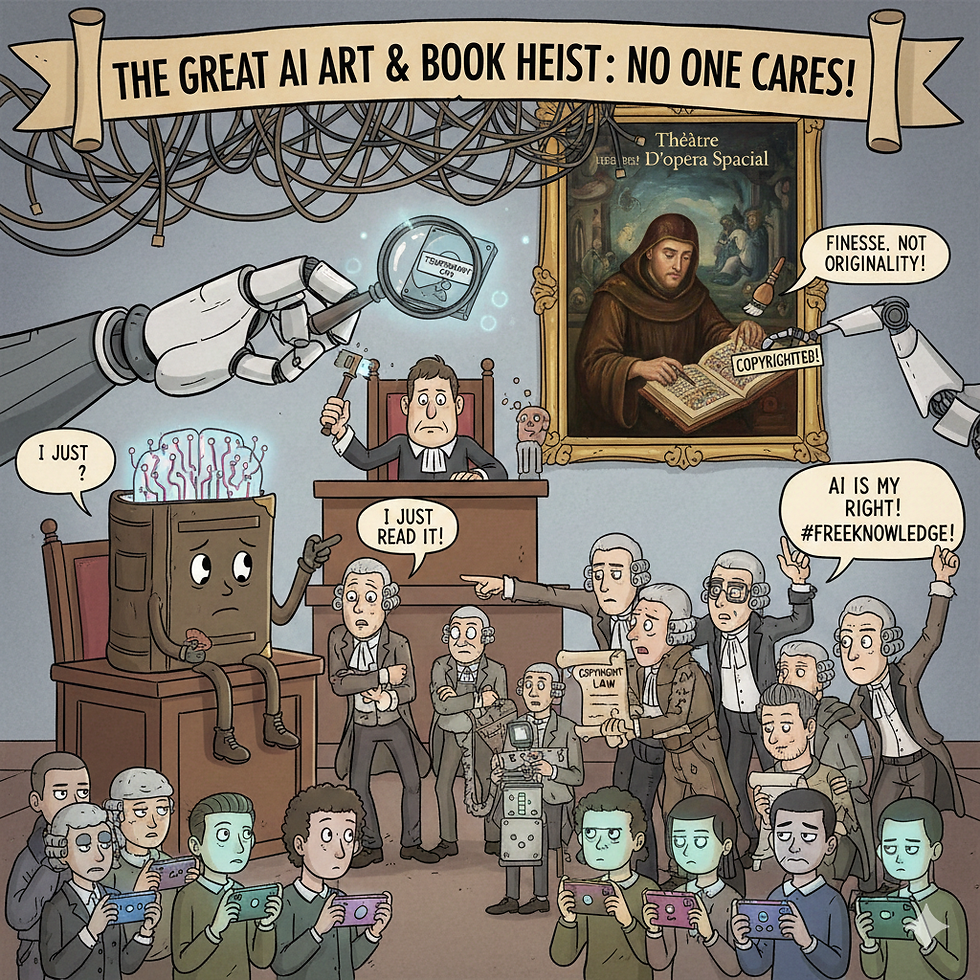
But hang on, I don’t need permission to read a book and “copy it to my memory”. What if I buy a second-hand book? Should the author get money? How about when I borrow one at the library? Should I pay every time I re-read a book or lend one to a friend? Whilst there is a precedent for this around the resale of unique art, there has never been for written work.
Whilst technically, copying material is a breach of copyright, one could argue that in the modern world, we need to rethink if this definition still makes sense. Is it really so different for a neural net to “read” a book and learn from it? Even if that does involve a temporary copy stored on a hard drive somewhere.
Some authors, like Ian Bogost are actually excited to see their work appearing in the data set. As he writes in his article: My Books Were Used to Train Meta’s Generative AI. Good. It can have my next one too.
Should we create legislation on AI model data training?
Probably!
But if history tells us anything, we won’t and if we do, it’s probably already too late.
Moreover, the next generation simply won’t care or understand anyway. Do you care that weavers lost their jobs at the start of the 19th century?
What would new legislation look like?
The idea of copyright has evolved and changed over time and will no doubt continue to do so. At the moment, copyright favours originality, but back in the middle ages, originality wasn’t valued, it was finesse and precision. Layouts, decorative motifs, and imagery were often copied.
“The current law on copyright and related rights should be adapted and supplemented to respond adequately to economic realities such as new forms of exploitation.” - The European Union
There are also some interesting developments and cases surrounding how AI-generated artwork should be considered with regard to copyright. Such as Jason Allen and his AI generated Théâtre D’opéra Spatial. Interestingly, in China too where an AI generated artwork was deemed as having copyright! Cases like these are leading many to suggest AI-generated art should be treated more like photography. I’ll be watching to see how this evolves!
There are also people that believe that AI is a constitutional right, defended by the first amendment. Whilst I have no experience in American law, I do believe that cases like these will have a global impact on how AI is used and legislated.
Maybe there should be an opt-in policy?
The idea of an opt-in policy on new artwork is great in theory, but almost impossible to regulate. Whilst someone might tick “no” when uploading an artistic work to the internet, as soon as it’s available to others, it’s going to be challenging to stop someone copying this file and reuploading it elsewhere. Particularly when varying international rules and regulations are considered.

Will the “AI-generation” feel the same about copyright as us?
Just as we happily buy mass-produced furniture and clothing without much thought, maybe the next generation will be dismissive of copyright protection in the same way. Maybe they will create artistic work for the benefit of culture and society and not for profit? Who knows?

Conclusion: Is there copyright infringement in AI-generated artworks and what should we do about it?
Whilst it’s likely legislation is coming, it’ll probably be too little too late. And new controls on if your work can be used to train AI will be almost impossible to regulate and enforce.
Ultimately, we have to ask ourselves the question. Why are we creating artistic works in the first place?
If I create a drawing, do I walk around telling people they are wrong for it inspiring joy or hope, when I intended sorrow? Or am I simply pleased to know that my work has fuelled “something” in the mind of someone else?
I believe that AI will be a greater benefit than hindrance to society, from protein synthesis and new medical treatments, to awe-inspiring artworks, we are just getting started! And personally, if anything I create can be used as the foundation of an immortal AI model, then part of me can live forever and, as a Sci-Fi nerd, that’s pretty cool!
You have the option to shape the future. Embrace it, don’t hide your creativity and brilliance in the name of profit or fear, share it with the world! Work with AI and not against it and explore the new possibilities.
What do you think? Is it really you that wants to “destroy all humans”? Are you simply angry because AI giants like Meta and OpenAI are “profiting” (they might not be) from your drawings? Do you think an opt-out scheme would work? Let me know!

Comments